

TRIUMPH OF LOVE: The Recording Session
Page 2
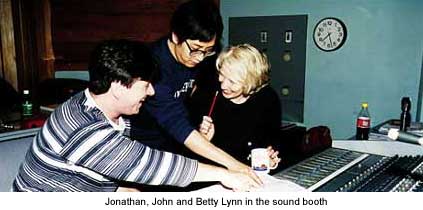
Joseph Thalken is actually seated at the piano at this point, since Brady’s plane has been delayed due to inclement weather. By the time “Henchmen Are Forgotten” is recorded, Brady has arrived and takes his place at the piano. Buckley and Abraham are now in place at their microphones to do a run-through of the show’s opening number, “This Day of Days,” and Norman, one of Buckley’s brothers (who is in town working on a film) arrives and joins those of us in the sound booth.
Soon after, Buckley’s incredible voice begins to fill the room as she sings, “See how the sun rises in fire/Higher and higher it soars/And wait for the moment/This glorious moment/When Sparta is once again yours.”
It really is a thrill to hear Buckley’s booming voice,
with its unique shading and silvery vibrato, come through the
two large speakers on the walls of the control room.
After this first rehearsal,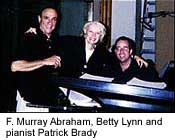 Buckley and Abraham decide to run
through the song again, this time at the piano.
Buckley and Abraham decide to run
through the song again, this time at the piano.
By 3:45, the first take of “This Day of Days” has been recorded, and John Yap asks Betty to move just a step closer to the microphone so that the recording will have the brilliance of her sound that he heard during the rehearsal of the song. Four takes of the opening song have been recorded by 4:10, and everyone is happy with the results, so it’s time to move on to the next tune, which will be the show’s first act finale, the haunting “Teach Me Not to Love You.”
Three takes of “Teach Me Not To Love You” have been recorded by the time it’s half past four, but Betty is not completely happy with the sound and wants to make sure that her voice has as intimate a sound on this song as it did in the theatre. John Yap decides tospend the remaining time before the dinner break on “Teach Me” and move “Have a Little Faith” to tomorrow’s evening session. By 4:50, “Teach Me” has been recorded, and it’s time for a well-deserved rest as members of the cast, orchestra and sound crew head out for dinner.
By 6:00 the 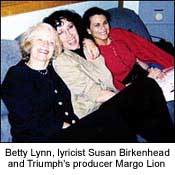 orchestra members are back in their seats, and a photographer
from In Theater Magazine, Bruce Glikas, has arrived to photograph
Betty and F. Murray’s recording of their second act duet, “The
Tree.” During the first take of the song, someone in the control
booth notices a soft squeaking sound emanating from the conductor’s
podium. A few mats are placed beneath the podium to avoid the
sound, and Betty and Murray’s microphones are adjusted so they
can face each other–as they did in the show–while recording their
duet.
orchestra members are back in their seats, and a photographer
from In Theater Magazine, Bruce Glikas, has arrived to photograph
Betty and F. Murray’s recording of their second act duet, “The
Tree.” During the first take of the song, someone in the control
booth notices a soft squeaking sound emanating from the conductor’s
podium. A few mats are placed beneath the podium to avoid the
sound, and Betty and Murray’s microphones are adjusted so they
can face each other–as they did in the show–while recording their
duet.
The delivery of this song by both actors is extremely moving, and I am particularly surprised how touching Murray’s readings are considering how little singing experience he has had. It is now a quarter to seven, and the band runs through “Love Won’t Take No for Answer.”
Three takes are completed of the song, and at 7:10 the orchestra is rehearsing the recitative. While the orchestra practices, I have a few minutes to chat with James Magruder, Triumph’s book writer. Magruder seems quite enthralled with the recording of the musical and tells me that he had once admitted that he would be happy with the experience of this show if he could have “a poster and a cast album,” and, soon, he will have both.
Currently working on a novel about love, Magruder also confided that he would love to work on another musical with Triumph’s creative team, especially Triumph’s lyricist, Susan Birkenhead, and director, Michael Mayer. Perhaps they could write Buckley her own song cycle, akin to Andrew Lloyd Webber’s Song and Dance and Maury Yeston’s December Songs. . .just a thought. . . .
By 8 pm the recitative has been recorded, and F. Murray is ready to perform his section of “Emotions.” By 9 pm Betty is set to record her duet with Susan Egan (who will add her portion of the song on Tuesday), “You May Call Me Phocion.” The first day of recording is now complete, and the cast departs at 9:30, ready to return tomorrow afternoon.
Day 2
Day 2 of the recording has arrived, and this is the day I am
most looking forward to, since 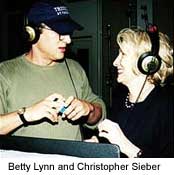 Betty will record her show-stopping
song from the show, “Serenity,” as well as her second-act number,
“If I Cannot Love.” During the first 45 minutes of today’s session,
the orchestra records the tracks for “Have a Little Faith” and
“Anything,” so that the singers can record the vocals at a later
time.
Betty will record her show-stopping
song from the show, “Serenity,” as well as her second-act number,
“If I Cannot Love.” During the first 45 minutes of today’s session,
the orchestra records the tracks for “Have a Little Faith” and
“Anything,” so that the singers can record the vocals at a later
time.
As 3 o’clock approaches, the musicians are rehearsing “Serenity,” which features a beautiful, tug-at-your-heartstring lyric by Susan Birkenhead, whose work throughout the piece is consistenly intelligent, soulful, and often, inspiring. Buckley is now in place at her microphone (John Yap informed me that he brought this microphone over from London expressly for Betty, the same mike he has used for some of the theatre’s other leading ladies over the years), and it is fascinating to watch her record this show-stopping tune: Not only does her voice fill the recording studio in a way that no one else has, but her whole body and face move in response to the song. After the first take, Buckley expresses her desire to “have a marriage of the voice and instruments, so that the sound resonates together.”
Another wonderful take of the song is completed, and Buckley joins the group in the sound booth to listen to the playback of both versions. She and lyricist Birkenhead discuss whether Betty should speak the word “cruel”–in the line “cannot beguile that cruel, untenable tyranny”–as she did in the show or sing it for the recording.
The two agree that even though speaking
the word was very dramatic in the theatre, for the recording it
would be better to sing the word. It is slight modifications in
her work that make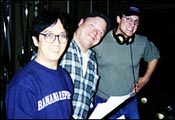 Buckley such a riveting performer, and when
she returns to do a third take, her version is even more thrilling
than before. Buckley requests one last take, and to everyone’s
surprise, this version is the best of them all.
Buckley such a riveting performer, and when
she returns to do a third take, her version is even more thrilling
than before. Buckley requests one last take, and to everyone’s
surprise, this version is the best of them all.
“Serenity” is completed by four o’clock, just as the show’s prince, Christopher Sieber arrives. The next half hour is spent recording his solo, “Issue in Question,” and Sieber, who has been cast as the Olsen twins’ dad on a sitcom for this fall, sounds great, building the song to a wonderful high note at the end. The orchestra records the three different sections of “What I Have Done,” for Egan to sing to on Tuesday. By this song’s conclusion, it is now time for dinner.
Immediately following the break, Nancy Opel, Roger, Kevin and Chris record “The Sad and Sordid Saga of Cecile.” By ten of seven Betty records the show’s wonderful closing line: “Maybe we’ll meet someone at the wedding,” and a few minutes later she readies herself to record her second-act solo, “If I Cannot Love,” which was cut during previews for storytelling purposes. Yap wisely realizes that Betty’s appearance on the album will be the main reason why most people will purchase the album, and he is anxious to record any tune that involved her.
While Betty rehearses, 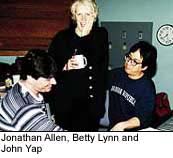 producer Margo Lion talks to me a about
producing for the theatre. “It’s all about the process,” Lion
admits “and [having] a joyful experience.” She relates that she
has received many calls about a recording for Triumph, a show
that she feels audiences enjoyed more than any other show she
has produced.
producer Margo Lion talks to me a about
producing for the theatre. “It’s all about the process,” Lion
admits “and [having] a joyful experience.” She relates that she
has received many calls about a recording for Triumph, a show
that she feels audiences enjoyed more than any other show she
has produced.
By 7:50 Betty is ready for her first take of “If I Cannot Love,” and the results are spirit-rousing. To listen to the way she builds the song, from a quiet contemplative mode to the more joyful, full-voiced finale is a lesson in song interpretation. And her sound on the song’s final line–“If I cannot love, I’ll learn, I’ll learn, I’ll learn”–is nothing less than thrilling. Deciding that nothing could top hearing “Serenity” and “If I Cannot Love” recorded, I left the studio at 8:15. It’s been an emotional experience, not only to hear such wonderful voices and performances, but to realize how beautiful much of the score is. When I attended the show in the fall I was particularly impressed with “Serenity,” but did not realize how wonderful many of the other songs are.
Listening to the tunes during these past two days, I was struck by the beauty of much of Susan Birkenhead and Jeffrey Stock’s work, particularly “Teach Me Not to Love You,” whose lyric is as beguiling as the tune; “This Day of Days,” a bouncy, uplifting melody; and two of Buckley’s duets, one with Abraham (“The Tree”) and the other with Egan (“You May Call Me Phocion”). The Triumph of Love recording on Jay Records promises to be a terrific addition to the musical theatre canon.